
What Cabernet Day Meant To Me

Well it’s past midnight so I can start reminiscing about Cabernet Day.  In part, that means sniffing empty bottles and thinking about opening more.  But the part of me that’s still sober is neurotically over-analyzing the event, and maybe I can bring you some fun conclusions about Cabernet Day and the Languedoc.

Cabernet Day

If you know me, you know I’m a fan of the Languedoc so I was really happy to use Cabernet Day as an opportunity to communicate on some of the wonderful Cabernet made in this region.  A lot of the time, we’re more known for our mass produced lowland Cab, which is a shame, because we have some stellar examples of Super Cabs.

I thought tonight would be a chance to get a few friends together to drink Cab and Internet-users would be able to tune in and see that folks in the Languedoc are drinking Cabernet and loving it.

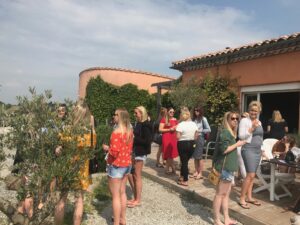
I was overwhelmed by the support I got.  My neighbors from Chateau Jouclary and Pennautier and Auzias and Rivals and la Cave de Cavanac.  That’s a huge honor because these folks have been making wine longer than me.  A couple of them were even crucial in forming the AOC Cabardes.

dad pours at Cabernet Day

Anyway, it was really great to see them because it’s tough to get locals motivated sometimes.  People often say “never a prophet in his own land” or something like that. I think it’s a biblical proverb.  Anyway, I feel like sometimes my neighbors don’t want to accept that there is a huge opportunity on the Internet.  Well tonight they proved me wrong by demonstrating an exemplary curiosity that can move this whole region forward.

Also, I think it should be noted somewhat humorously how far I missed the mark on planning this event.  I set up a big TV with a feed of all the tweets about Cabernet Day.  But this didn’t really mean anything to about 80% of the people who came because they had no idea what Twitter was.  So we talked a fair amount about social networks and real time media.  It made for fun conversations.  I was blowing their minds.

But probably the biggest mind blowing experience for me was encountering a journalist who told me he remembered the pre-war owners of this vineyard.  PRE WAR? Which war you ask?  The War of ‘39.  He actually called it that.  This VERY interesting man told me all sorts of things about my vineyard.  It warrants its own post on a later date.  I thought the guy was going to interview me because he was a journalist.  But in fact, he knew so much about this property, I ended up interviewing him.  It was really great learning some of the back story on this very interesting piece of land.

Anyway, I’m rambling. Because I’m tired. And drunk. But the point is that there were some great exchanges.  I’m really happy with the wonderful night we had around some glasses of Cabernet.  A big thanks to Rick Bakas for organizing this whole thing.  A big thanks to everybody who came.  And the biggest thanks to all those brave souls out there who honestly make the best Cabernet they can.

Tasting notes and more serious stuff including the video of our live party cam can be found at Love That Languedoc’s Cabernet Day article.

For now, good night, good night, sweet Cabernet!

Tags: , , , , , , , , ,

The Letters of the Law – AOC, AOP, INAO, ODG, CIBAS, OI, ETC. explained

What do all these letters mean?

I recently wrote about Lilian Bauchet getting controlled.   Those of you who read French, check out Lilian’s whole post as he does a good job of explaining the rather convoluted delineation between the various organizations in the alphabet soup that legislates our vineyards. ODG, INAO, CIBAS, ETC.

For those of you who don’t really read French, here is my explanation:

Basically (hah!), to make AOP wines (AOC is now called AOP, stick with me), you have to belong to an ODG. The ODG has a constitution that states all the rules of your AOP. The ODG sends that constitution to the INAO which is a national organization that will approve your constitution or recommend modifications. Then, there are independent control groups which are tasked with the enforcement and management of certain bureaucratic procedures tied to the ODGs. These control groups vary by region but are always INAO-approved. And working with them is not optional. So essentially they are INAO-mandated, but if they do something wrong, the INAO can just say “oh well you have to complain to them not us”. In Lilian’s story, the control group is the CIBAS, but in my region it’s the OI (I think).

Also, the INAO encourages the ODG to perform regular and random auto-controls where we inspect each other’s vines. Then the control group like the CIBAS just has to control a portion of our controls to verify that we’re doing a good job on our own. This is probably why the dude checking Lilian’s vines out was a grape growing neighbor of his.

And you can’t just lump all the abbreviations and wine laws together.  Because while the majority of these letters belong to a similar group, some function independently or parrallel to the above acronyms.  The CIVL, CIVR, CIVB, etc. are interprofessional groups.  They are supposed to represent all growers.  They are technically separate from the AOPs even though most AOPs are adherents that pay to be represented by the region’s CIV.

Furthermore, the IGP system is a more centralized European classification that doesn’t necessarily have any correlation whatsoever to AOP, VDQS, VDP, or VDT classifications.

And then you have all the regional bodies that aren’t law makers but essentially marketing and events firms like Sud de France, InterRhone(?), Vins de Bordeaux(?), SOPEXA(?), etc.

What do the actual letters stand for?  Good question.. I think the following:

  • INAO- Institut National des Appellations d’Origine (although their own website says it stands for “Institut national de l’origine et de la qualité” but INdlOedlQ was less catchy.)
  • AOC- Appellation d’Origine Controlée
  • AOP- Appellation d’Origine Protegée (exactly like AOCs but with ironically more Controls)
  • ODG- Organisme de Défense et de Gestion
  • OI-  ???? the inao-approved group that Cabrdes ODG uses to enforce our rules
  • CIBAS- ??? the inao-approved group that Bourgogne sometimes uses
  • IGP- Indication Géographique Protégée
  • CIVL- Conseil Interprofessionnel des Vins du Languedoc
  • CIVR- Conseil Interprofessionnel des Vins du Roussillon
  • CIVB- Conseil Interprofessionnel des Vins du Bordeaux
  • BIVB- Bureau Interprofessionnel des Vins de Bourgogne
  • VDQS- Vin de Qualité Superieur
  • VDP- Vin de Pays
  • VDT- Vin de Table, soon to become Vin de France(?)

So there. You don’t need to ask what does AOC stand for anymore.  Now you know.  And you also know that you’re supposed to be asking what AOP stands for.  Keep up with the times!

Tags: , , , , , , , , , ,

Cabernet Day Streaming Live

Cabernet Day is tomorrow!  September 2nd.  The wines and last minute RSVPs are filing in.

And you can still come too!  I hope a lot of you swing by Domaine O’Vineyards tomorrow starting around 19h00.  We’ll have some stellar wines open.  You can show up earlier, but we’ll put you to work. ;D

For those of you who cannot come in person, you can still follow along on the live streaming broadcasts.  I’ll have a laptop set up to broadcast a live stream through Live That Languedoc, my ustream channel.

And I’m not the only one. California Wine TV will also be streaming!  I think that their stream will be found on a ustream channel too.

I finally got the flastcreen set up to show cascading tweets all hashtagged with #Cabernet Day.  So you had best be tweeting your little hearts out.  Tweet til the Cab ripens!

Or if you don’t tweet, feel free to leave a comment in this post or in other posts about Cabernet Day.

See you all tomorrow!

Tags: , , , , , , , ,

Does the French government snoop through your wine blog?

Does the French government snoop through your wine blog?

Finally a post where I can really flex my paranoia muscle.  But before getting too far ahead of myself, let me say that my answer to the question in the title of this post is “No, the government doesn’t really snoop through your blog, but it CAN and it MIGHT!”.   The heavily anti-wine atmosphere in the French government coupled with a new series of reforms in the way winemakers are controlled can cause a bit of paranoia in a place where a ton of crime is discovered through dénonciations.

A recent story popped up in the Beaujolais that has paranoid winemakers like me wondering how much of the vines we can safely show on our blogs.

Lilian Bauchet’s inspection

The story that has me thinking comes from Lilian Bauchet who recently came to my attention as a bit of a French blogging sensation.  He’s an offbeat blogger working in the Fleurie (an appellation within Beaujolais) and he’s got no nonsense and a lot of personality.  So when he blogs, he says what’s on his mind and it can be pretty colorful.

His vines were recently subject to an unannounced inspected by a government-approved control group (I’ll explain this later).  And somewhere, in the back of our heads, we start to wonder how his vines were chosen for inspection.

“A moins que le récit de mes aventures de néovigneron dans les vignes sur ce blog ait intéressé à ce point les gens du CIBAS qu’ils se décident à venir y jeter un œil de plus près ! “

Lilian’s comment is tongue in cheek.  But still… is there a chance that blogs bring unwanted attention to the vineyard?

Obviously, the control groups cannot inspect every single vine in France.  So they have to select a few parcels from a few winemakers and they rotate through a representative sample of vines every few years.  But we all know that it’s tough to be random.  And hearsay, rumor, and politics can often influence these decisions.

Is there a risk that outspoken blogging can win the attention of bureaucratic enforcers?

Why I think we’re mostly safe.

I feel sort of silly saying this next bit.  The good news is nobody in the business reads our blogs!  I don’t think that folks in the control offices, or at customs, or the prefecture, or even our fellow winemakers spend time reading our blogs.

Most of my direct neighbors in the winemaking community have just a vague notion that I do something on the Internet which has inexplicably raised sales and they usually narrow their brows and raise their shoulders when they talk about it.  And they occasionally say something about facebook.

Even people who seem overly dedicated to antagonizing me don’t seem to really look at the website.  I have neighbors who are constantly denouncing me to the cops for weird pseudo-crimes that I’m not committing… if those guys ever started reading my blog, they’d probably be able to denounce me for an actual crime that I’m really committing!

I mean, I run more than one website dedicated to wine without slapping around that disclaimer required by the Loi Evin about “l’abus d’alcool est dangereux pour la santé” or whatever.   But no popo.  These laws go almost entirely unenforced, to my knowledge.

Where are the blog police?  They don’t exist…yet.

Will the Blog Police Exist One Day?

That’s a good question.  Does the RG (Renseignement Généraux) read the blog?  They certainly could.   But could they read ALL the blogs?  It’s sort of a major time suck.  And as the years go by there are more and more active sources of information online.  Eventually, the RG is going to face the same problem every intelligence organization faces.  They will have access to too much information.

And the same can be said about the CIBAS or OI.  Determining which vineyards to inspect based on blogging is likely to remain a silly fiction spun by paranoid winemakers like me.

On the other hand, I’m always surprised at the lengths spiteful neighbors or rival winemakers will go to just to piss each other off a little.  While the blog police won’t likely be a government institution any time soon, I do think citizens will be denounced more and more often for their blog-confessionals.

Thanks to Iris for pointing me to Cotes de la Moliere’s post on this subject.

Tags: , , , , , ,

What subjects do winemakers blog about?

I noticed that Hervé Bizeul has been on a self-reflective flurry, pontificating on what defines a wine blogger’s philosophical imperatives or something. The point is we all wonder what to blog about at some point or another.

I thought it would be funny to share this pie chart that breaks down the content of most Winemaker Blogs and Newsletters.  Hopefully O’Vineyards blog and newsletters don’t feel like this. ;D

winemaker content pie chart I’m teasing of course.  But there are a lot of newsletters that quite predictably remind you the harvest went great, the wine is available through direct orders, and… well nothing else.

While more introspective winemakers like Hervé and me wonder if we should burden people with our daily chores, tales of the stuff that breaks down, worried scribbles about the weird mole on our backs… …. The most important thing is just to have fun and be yourself.  As long as you’re not treating your audience like a bunch of mindless wine-buying automatons, you’re doing a good job.

Here’s a more detailed version of the pie chart that includes a few more options:

graph(2)

  • Best harvest ever
  • Buy my wine
  • Sorry I haven’t been updating
  • It is hot
  • It is cold
  • The grapes changed color
  • I’m at an overpriced wine fair
  • I was mentioned in a magazine you don’t read
Tags: , , , , , , , , ,

Inspiring Bloggers – Sud de France Changing Course

I’m always out there trying to convince Languedoc Roussillon wine people to blog. But sometimes I feel like my proselytizing is a big waste of time. Because outside of a few very devoted winemakers who are taking up the charge to explore the Internet with me, I see very few results. I hear a lot of excuses. A lot of complaints about time management. I also get a lot of people who sort of stop talking to me and who go out and pay a designer to create a blog for them (something I would have done for free). And then the people in that last group often post once or twice about the weather and then never again.

I just get down in the dumps when I see this lack of enthusiasm.

But there is still hope around every corner!

I recently noticed a change from one of the region’s behemoths. You know how long it takes for big organizations to implement change. So if they’re altering their course, maybe it will inspire the little guys to do it too.

Sud de France used to have one of those embarassing blogs that posted a small bit every six months. And I noticed that they’ve published two posts in August alone. It’s a little early to call it, but I’m guessing that somebody over there is waking up to the huge opportunity they have.

Then again, if you look at the archives, August-October is the only period they actively blogged in 2009 as well. So maybe it’s just an annual flurry of posts (maybe tied into the Festival Sud de France). I hope it’s more than that. Because if they can’t be bothered to highlight all the people talking about their brand, I don’t know how I’ll ever convince poor, resource-starved winemakers to do the job for them.

I also hope that they personalize it a bit more. Put in a photo of whoever is writing the blog. Let that person write it in a personal, human tone. Et cetera.

Tags: , , , , ,

You Can’t Argue with Fruit Thieves

There’s really no winning with these fruit-picking neighbors. Dudes are just totally indignant.

I walked up on this guy taking my figs and there was a wicker basket on the ground by one of the trees. So I took the basket and started walking off. And he got incensed! He can take my fruit but I can’t take his basket?

Here is an English summary for those who don’t know French or stream video. Although dumb-looking facial expressions are sort of an International language.

He tries to explain that he didn’t know who the trees belonged to despite the huge orange building that stands by these trees. Obviously, the basket analogy went over his head.

He also tries to justify his action by saying that he’s been stealing the fruit here for years.

He asked what I expected of him and I explained that I wish people would at least ask for permission before romping through our fruit trees. So he eventually slows down and asks for permission. And I kindly give him back the kilo+ of figs he had collected. He then asks if he can pick more and I say that he can take what’s already picked but if he wants to pick more he should do us a favor by bringing some to us. This too seems to upset him greatly.

He complains that he has no fruit trees at his home and that is why he takes ours. I ask him if he has any furniture I can borrow when he’s not using it. Also, this is apparently not comparable in the man’s mind.

He then marches off. I ask him his name and he says it’s Rodriguez Garcia. Either that’s a pseudonym or he’s actually named after the inventor of the laryngoscope.  Either way, it’s the perfect place to end this story.

Epilogue – I followed him off the property and he went to my neighbor’s vines. Upset that I was following him, he asked me if these fig trees in the distance belonged to me too. I said they don’t belong to me, but they belong to somebody. And that upset him too. I really wish I hadn’t given him any of the fruit back. Such a jerk.

Tags: , , , , , , , ,

The New “Red” Cross

Here’s a nice light hearted laugh in a time when it seems the French government is really set on vilifying red wine. I love this logo and hope Glougeule makes a killing selling shirts with this new emblem for the French Red Cross.

A clever pun as Croix becomes Crois, urging the reader to believe in Red! Yes we can. :)

Tags: , , , , , , ,

Bordeaux Buying Languedoc Wine

Jancis just wrote a very cleverly titled article “11 into 33 does go” (you have to subscribe to read the whole thing).  This is more than just a simple math question.  It’s a reference to French department numbers.  11 is Aude (Languedoc) and 33 is Gironde (Bordeaux).  And this article talks about the sad truth that nobody likes to discuss.

While tons of our region’s wine cooperatives flounder and go out of business, there are still some cooperatives and negociants with tankers pumping wine nearly 24/7.  It makes you think that there’s a lot of hustle and bustle.  But where is the wine going?  And at what cost?

Well, a short inspection of the license plates reveals a lot.  All the tankers filling up with Languedoc wine have license plates that read 33.  Gironde. Bordeaux. It’s nearly impossible to prove what happens once the wine gets into the winery since the French classification system is almost 100% enforced by paper trail alone.  But that’s where the wine is going.  Or at least, that’s where the trucks came from.

I’m really happy to see a writer of Jancis’ level talking about this issue because it’s a real wine story.  Not a lot of that in wine journalism today.

Tags: , , , , , , , , , ,

Grands Vins / Grand Crus Tiers in the Languedoc

The CIVL (Conseil Interprofessionnel des Vins du Languedoc — but I’m sure you knew that ;D) has declared a new system of classification in the Languedoc to separate and celebrate the “Grands vins du Languedoc” and “Grands Crus du Languedoc”.  Articles in Harpers and Drinks Business for the full story.

A lot of people have been asking me what I think about this and I guess I should take a moment to express my personal feelings about how the CIVL’s newly declared hierarchy.

On the one hand, the Languedoc is certainly entitled to having some Grands Crus or terroirs/wineries that have proven themselves over time to be emblematic champions of the region.  It might seem absurd or capricious today to arbitrarily say that certain places or people are better winemakers than others.  But hey, fake it til you make it.  In a hundred years, the Grands Crus du Languedoc might seem  just as legitimate as the Grands Crus de Bordeaux or Grands Crus de Bourgogne (determined by the laws from 1855, parcel drawings of Cistercian monks, and other really legit old stuff).

That said, it’s a pretty classic move for my dear region.  At a time when so much of the world mocks the complexity, capriciousness, and obsolesence of the Grands Crus system in other parts of France, we establish a long term plan to incorporate it into how we sell wine.  We’re about 200 years too late.  But hey, it can’t really hurt us.

At worst, a couple of people (generally folks who are “in the know” about wine) will ridicule the effort.  But at best, we can seriously raise self-esteem in the area.  We have to throw our old defeatist attitude in the rubbish bin.  The Languedoc is GREAT.  And we have Grands Crus too!  Power to us.

Now, what do we hope to gain from it?  Other than just being a positive mantra to sort of repeat to yourself as you wake up each morning?  I don’t know.

When Frederic Jeanjean, President of the CIVL and owner of Jeanjean (edit: large groupe viticole based out of Terrasses du Larzac) says the strategy will “transform the Languedoc into a profitable, quality wine‐making region”, I think that’s a little ambitious.  Really?  Calling certain wines and crus Grand is going to transform the Languedoc into a profitable quality winemaking region?  That’s a tall order.  What exactly is the strategy being referred to?  Well, the Drinks Business article alludes to “a detailed action plan of technical, economic and marketing strategies, which will provide a framework for its activities over the coming years.”  Let me tell you, that I have not seen much of that detailed plan of action.

Short of checking the CIVL news site (which I really like), I don’t get much news from them at all.  You might assume this is some fault of mine, but let me clarify my relationship to the interprofession.  I am forced to pay dues to put AOC Cabardes on my wine bottles.  And a significant portion of those dues goes to the CIVL.  So I am a paying member of the Interprofession.  Then they also send you letters and try to get you to pay as an individual.  So they have my address.  But they don’t send me invitations to the assemblee generale.  Just more requests for me to make double payments on my wine production.

Here’s the only thing I have received regarding the new hierarchy plan, copied and pasted from an email sent within the AOC Cabardes ODG (our syndicat):

Premier niveau : LES VINS DU LANGUEDOC

ð Niveau d’objectif : entre 3 et 4 € par col (prix TTC consommateurs) et pour les marques de distributeurs : 2,50 € par col (prix TTC consommateurs).

ðPrix vrac d’objectif : 90 à 100 € l’hl avec un rendement de : 50 à 55 hl/ha

ðPrix plancher d’objectif : 80€ l’hl.

Deuxième Niveau : LES GRANDS VINS DU LANGUEDOC

ðNiveau d’objectif :entre 4 € et 7 € par col (prix TTC consommateurs).

ðRendement de 48 à 50 hl/ha

ðPossibilité de repli en AOC LANGUEDOC (a priori pour le Cabardès sous réserve d’identification par l’INAO des parcelles complantées en cépages méditerranéens)

Troisième Niveau : LES CRUS DU LANGUEDOC

ðNiveau d’objectif : au-delà de 7-10 €/cols (prix TTC consommateurs au caveau)

Les AOP du Languedoc seront réparties entre le deuxième niveau (les grands vins du Languedoc) et le troisième niveau (les crus du Languedoc) en fonction :

- du souhait de positionnement des ODG de chaque appellation

- de critères économiques précis garantissant l’homogénéité du segment de marché.

Les critères économiques retenus en première analyse pour accéder au segment « crus du Languedoc » :

- nombre de producteurs (entre 30 et 50 metteurs en marché),

- volume de production (entre 25.000 à 35.000 hectolitres commercialisés),

- rendement maximum (45 hl/ha : critères INAO 2008),

- prix vrac (>150 €/hl) ou pourcentage des ventes directes (>70%),

- prix consommateurs (caveau > 10 € TTC /  GD : > 7 € TTC ),

- mise en bouteille en région restreinte de production

And this is a CIVL powerpoint PROJET DE SEGMENTATION DE L’OFFRE DES AOC which ostensibly originates from that June assemblee referred to in the Drinks Business article.

So I guess the plan is just to limit each tier to a certain yield, certain price per bottle, total number of producers, certain size of plantation, and quantity of production (although this should really be a function of yield and size of plantations).

Anyway, this is a really long post just to say that I don’t really know what I think about this new strategy.  If the CIVL continues to operate in a way that even a winemaker like me who spends a great deal of effort trying to stay branché has no idea what they’re doing, I don’t see how this new system of classification can “transform the Languedoc into a profitable, quality wine‐making region”.  A rose by any other name.

But at the same time, I’m glad to see they’re sending out positive press releases and that people are reading that stuff.  Because hey, we deserve grands crus just as much as Bordeaux if not more.

PS – One of the execs at the CIVL said that the new hierarchy will “mould the future of the Languedoc region for the next 15 years.” … Even that seems a little ambitious.  I feel like I’m probably going to have more impact on this region than some system of classification put forth by the CIVL (who has lost a lot of gumption in the Freche years) but I guess that’s a subject for another post.

Tags: , , , , , , , ,